|
|
Titan Stick Insect, the Longest Insect - Acrophylla titan
Family Phasmatidae
This page contains pictures and information about the Titan Stick Insects that we found in the Brisbane area, Queensland, Australia.
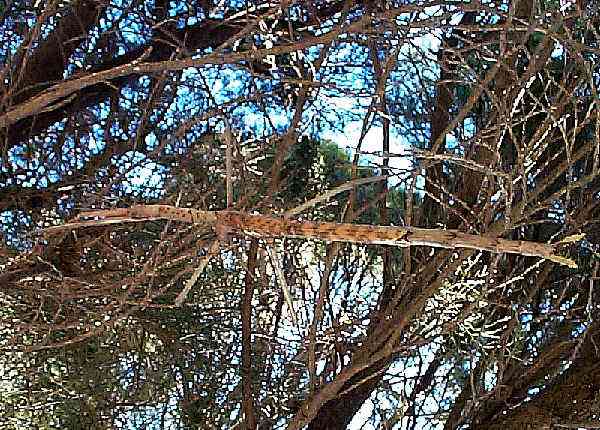
- Body length 250mm
- Titan Stick Insects are giant insect, they are the longest insect in Australia. The female adult body length is about 230mm. In term of weight, the Goliath Stick Insects and some species of Australian bush cockroach species may be heavier Titans. But in length, sure Titans are the longest in Australia, and perhaps in the world as well. They also known as Great Brown Stick Insects or Great Brown Phasma.

- This look like a stick, when we look carefully, yes, this is a stick.

- We found the Titan under this cypress pine tree in suburban area in Brisbane.

- I spent tens of minutes on each tree and, yes, I found the Titans.


- I look around in the near by area. About 100 meters away, there are some more cypress pine trees. I find there are six cypress pine trees in this area and totally I can easily see six female and one male. They are about two to three meters above ground. All of them are found on the tree side facing away from the sun. This made them harder to be found for you have to look at them while the sun light is shining at you face. I think this help them to hide away from predators.
Titans are in the family PHASMATIDAE, order Phasmatodea. The insects in this order are large to very large. This order includes the Stick insects and Leaf insects. They tend to resemble sticks and twigs, usually they are green or brown in colour. They spend much of their time hanging motionless in plants. Even if they move, they swaying slightly as if wind movement. They are not easily seen for their heavily camouflage. Stick insects have powerful mandibles. They are herbivorous, they eat plants only. Titans feed on leaves of cypress trees. But they also feed on eucalyptus in captivity. As most of other stick insects, Titan females are larger than male. The males are good flier but the females are poor fliers.
Searching for Titan
We know there should be the Titan Stick Insect in Brisbane area. However, besides in the Museum, we never seen any Titan adult in the wild. We found nymph which look like Titan but it is not so sure for a nymph is harder to be identified. We tried to raise this nymph to adult but not success. From Paul Brock's information Titan's food plants is 'Bribie Island Pine', so every time we go for bush walking, if we met trees look like a 'Bribie Island Pine', we will stop and look for Titan for a few minutes. But so far with out any luck.
One day (late winter) after lunch, as usual, I went for a walk near my office. Along a quiet street in Yeerongpilly, I saw hundreds of ants attending something on the ground. I thought it could be a dead worm. Come closer and I found that it was a stick, and was moving. I drove away the ants and saw a 20cm insects, still alive. I carefully took it home but it dead a day later. I think it must be the Titan, however, its antennae were missing, its wings were broken and only the base part were leave. Its body and legs are extremely soft and with some moulting skin still attached with it. So I think it must be fallen down when moulting and attacked by ants. This should be its last stage of moulting because there was the wings.
At least we found a Titan and know that the insects will do the last moulting in late winter. Any we can still find Titan in Brisbane.
I think to myself, if there is the Titan on the ground, it must come form some where on the tree. There could be some other Titans. So I went back to the street on the next days and recognized three cypress pine trees. I spent tens of minutes on each tree and, yes, I found two Titans on two trees.
One Titan is about 22cm in body length, fully winged and should be the female adult. The other one is 20cm in body length, with wing buds and should be the last stage instars. It was feeding on the on the pine leaf. They are about two meters about ground. I took the instars home and watch its growth.

The Female Titan Stick Insect
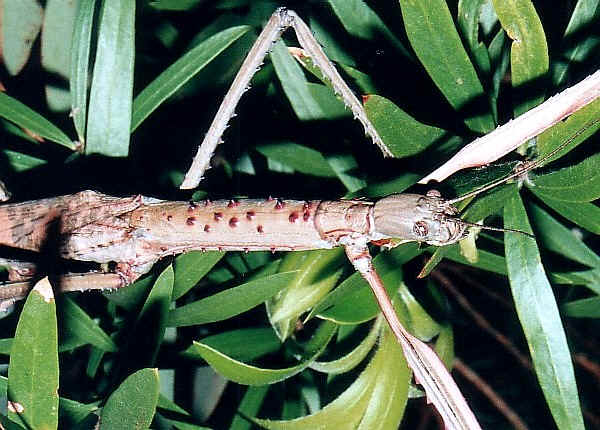
- Female adult Titans are dark brown in colour, with irregular grayish-pink spots on their bodies, legs and wings. There are the chequered brown pattern on its hind wings. When disturbed it will display the dark red colour under its wings, together with swishing sound coming from the wings to scare away the predator.


- A closer look at female Titan's head and wings
- Its first segment of thorax are spiny, 35mm. Its antennae are 35mm in length. All its legs are spiny and about the same length, 90mm. Forewings are 30mm long and covering part of the hind wings. Hind wings are 80mm long, covering half of the abdomen. When fully open, their hind wings can be divided into two part. The front part is as tough as its forewings. The second part is always fold under the front part which is chequered in pattern. Its abdomen is 110mm long.

- The mating couple, from this picture we can compare the size of the smaller male and the larger female.
- Male adult Titans are look similar to female except smaller in size. They are also dark brown in colour, with irregular grayish-pink spots on their bodies, legs and wings. There are the same pattern of chequered brown pattern on its hind wings.


- Male Titan's head and wings
- Its first segment of thorax is 30mm, with bright deep red colour spins. Its antennae are the only thing longer and thicker than the female, 70mm in length. All its legs are spiny and about the same length, 70mm. Forewings are 23mm long and covering part of the hind wings. Hind wings are 60mm long, covering 2/3 of its abdomen. The abdomen is 80mm long.


- Length 90mm
- Acrophylla titan, nymph, Family PHASMATIDAE
- Stick Insects are not easily seen for their heavily camouflage. Once we learn the technique to distinguish a stick insect from the background, to find a stick insect become not too difficult. We find this stick insect nymph in Wishart bush land. It look like Acrophylla titan nymph, where Acrophylla titan is the longest insect in Australia.

- To bring stick insect home for study is easy, we just find a branch of leaves and let it climbs on.
- This stick insect is brown in colour with forewings 3mm and hind wings 5mm in length. We can easily see seven segment on its abdomen. Its antenna is about 12mm. To bring it home for study is easy, we just find a branch of leaves and let it climbs on. It seems like to feed on the Red Bottle Bush leave. However, it die a week later.


- Length 120mm
- Acrophylla titan, nymph, Family PHASMATIDAE
- On 13/05/2001, we found another stick insect nymph in the same area. It was 120mm in length. Notice that its left middle leg was missing. It was resting on the a tree trunk one meter above ground (first picture). When we came close, it started to climb up the tree. We let it climb on a stick, bring it home and try to breed it to adult. We are quite sure it is a Titan nymph. In our Brisbane Museum there is a display tank rasing small stick insects including Titan Stick Insects. We have compared them with the nymph and they look exactly the same.

- Titan last stage instars feeding on cypress pine trees. Notice its developing wings buds. The spiny spots on its thorax are still not noticeble.


- After keeping the last instars for about a week, one night at about 10:00pm, it started to moult. Before the moulting, it hung up-side-down from the plant, motionless for one day. The above pictures show it already came out from its exuviae, or its old skin, expanding its wings. Notice that, different from katydid and grasshopper, its wings are kept close when expanding while katydid and grasshopper are open.


- When look up, there could be many stick insects, or none, very hard to tell.
- Reference:
- 1. The Complete Field Guide to Stick and Leaf Insects of Australia - Paul D. Brock and Jack W. Hasenpusch, CSIRO PUBLISHING, 2009, p94.
- 2. Species Acrophylla titan (Macleay, 1826) - Australian Biological Resources Study, Australian Faunal Directory, 1997.
The Male Titan Stick Insect
The Titan Nymph
From Nymph to Adult
I find one Titan larva which is about the size of an adults but its wings are still not developed. I know this must be the last instars and I take it home and watch its grow.
Stick insects will undergo some molting stages. After each molt, they will usually eat their exuviae.
Questions for Discussion
Why the Titan Stick Insects are so big?
Stick insects are large in size in general. One reason is they mimic a stick to hide away from their predators, usually birds or some other larger sized vertebrae animal. The camouflage will only effective to cheat larger predators. To smaller size predators such as spiders and praying mantis, sticks insect may not look like a stick. One of the solution to avoid those smaller predators is larger in size. This also explained why some stick insect mimic ants and not stick when they are in small larva stages.
For Titan Stick Insects, there may be many factors make them the longest insects. I notice one major factor which is theirs hugeness resemble the size of the stick on the tree that they feed on. They feed on the cypress trees. For those trees, beside some main trunks, most of the branches are about the size of the Titan's body. There are many branches in high density. If a twig fall from the top part of the tree, it usually hangs in the middle of the trees. When I look up from the bottom, I saw high density branches, live of dead, close together. There could be many Titan or none, very hard to tell. Titans mimic the size as well as the shade of the branches.

Also when I disturbed the stick insects, one of the defence mechanism I noticed was they try to put their front pair of legs straight in front of their head and make themselves look as large as possible. So I think hugeness is also one of their survival factors.
